
A Familiar Pattern
But what exactly is the pattern?

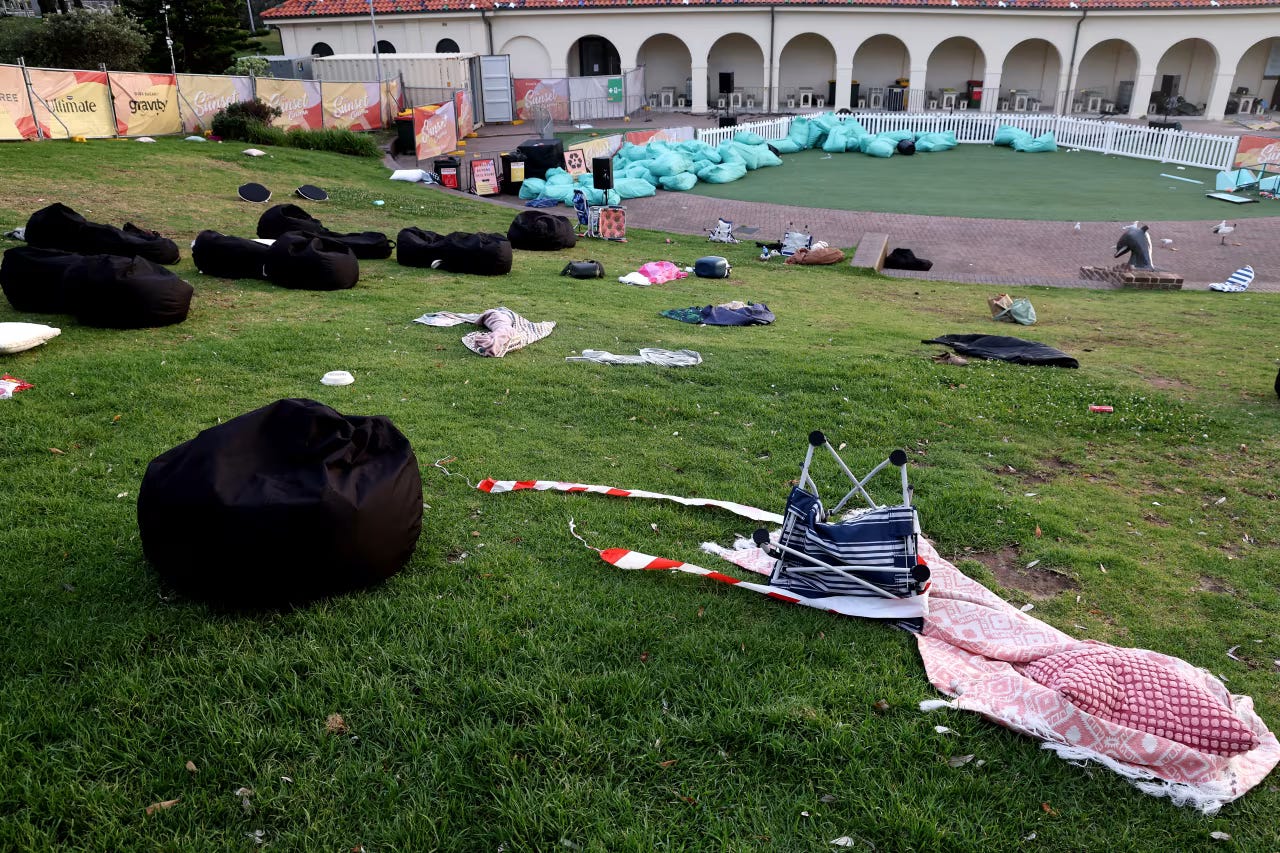
Yesterday evening, on Bondi Beach in Sydney, Australia, two men of Pakistani origin, father and son, opened fire on a gathering to mark the first day of Hanukah, killing fifteen people (source 1). Obviously, the incident fits into a pattern; but patterns are cheap: anything that happens fits into one pattern or another. What matters is how much a proposed pattern shows about what is happening more generally and what is likely to happen in the future. Adam Louis-Klein, in a short piece published in The Free Press (source 2), places the incident in the pattern of the spread of antizionism. (In the quotations that follow, I have replaced the compound expression “anti-Zionism,” presumably imposed by the editors, with Louis-Klein’s favored form “antizionism”—a choice whose basis I have written about in a previous blog post: source 3):
Though no manifesto has yet been released, the attack on Bondi Beach follows a clear and escalating pattern: Jews being targeted as a result of the intensifying anti-Jewish environment since October 7.
This pattern—an intensifying anti-Jewish environment since the invasion of Israel by Hamas two years ago—is obvious and undeniable. What requires brain-work is the question of why that has been happening. To a lot of people, the answer to that question is equally obvious: the world is reacting against Israel’s supposed atrocities against the populace of Gaza. Such an answer, besides the grotesque unreality of its premise of Israeli atrocities, is itself a cliché of Jew-hatred: it is an instance of the libel of blaming Jews for the hostility that is directed against them.
Louis-Klein goes on to identify a pattern of longer history and more-specific relevance (bold type added by me):
This latest assault only reaffirms the ongoing reality of antizionism as an essentially violent ideology—one that drives out Jewish communities wherever it takes hold, through exclusion, discrimination, and even murder.
This is not about a political opinion that “crosses the line” into antisemitic violence. We are dealing with antizionist violence itself: the targeting of Jews as “Zionists,” legitimized by specific antizionist libels.
This pattern is not new.
In Iraq in 1948, Shafiq Ades—a wealthy Jewish businessman who posed no threat to the state—was executed as a “Zionist traitor.” The label alone was enough to mark him for death. Two decades later, in 1969, nine Jews were hanged in Baghdad’s central square, accused of “Zionist” crimes as crowds gathered to celebrate their execution.
Across North Africa, similar patterns unfolded. In Tripoli in 1945, more than 140 Jews were murdered in a three-day pogrom sparked by rumors that local Jews supported “Zionist” aims in Palestine. In Oujda and Jerada (Morocco) in 1948, riots on the eve of Israeli independence killed dozens and triggered a mass exodus. In each case, accusations of “Zionist disloyalty” were enough to unleash violence against entire Jewish communities.
In Mandatory Palestine, the Mufti of Jerusalem incited mass violence by spreading libels that Jews were plotting to seize the Al-Aqsa Mosque—libels that helped ignite the major anti-Jewish massacres of 1920, 1921, 1929, and 1936, and that would later form part of the theological basis of Hamas’s genocide of October 7.
Under the Soviet antizionist campaign, the basic ideological architecture of antizionism was crystallized. The USSR canonized the core libels—“Zionism is racism” and “Zionism is Nazism”—and fixed Israel as the symbolic enemy of humanity. These same slurs now circulate every day, used to harass Jews online, mark them as enemies, and legitimate their social shunning and professional discrimination. The racialized figure of the “Zionist” forged in Soviet propaganda is the same target animating antizionist movements in the West today.
I see three principal points here. First, antizionism is not a reaction to Israel’s actions but a campaign of libel against the collective political self-determination of Jews in the land to which they are indigenous. Any pretended supporting case that is made, whether on a basis of facts or fantasies, about misconduct by the IDF is purely opportunistic. (This is not to say that there is no misconduct by the IDF; only that antizionism is not founded on it, or more generally, on anything that the state of Israel has ever done besides existing.) Second, the line that antizionists pretend to draw between “Jews” and “Zionists” always disappears in practice. And third, the line between “political opinion” and violent practice also always disappears. There has never been an antizionist movement that does not manifest itself in a progression from anti-Jewish bias to persecution, violence, and expulsion; and that, according to Louis-Klein, is what we are seeing in the Bondi Beach incident.
I am not satisfied with this explanation. Most exponents and adherents of antizionism will indignantly refuse to be tarred with the brush of anti-Jewish violence. Many of them, after all, are themselves Jewish, and affirm their Jewishness without stint or apology. I can imagine one of them saying (and I could probably find apposite quotations if I bothered to hunt around), “We are not responsible for the ways in which some bigoted persons and extremists have acted in the name of our cause. We believe that there should be a state for all peoples in Israel-Palestine, without any one of them defining the ethnic or religious character of the state.”
I think that Louis-Klein’s reply to this would be that the conceit that this time, in our special case, antizionism is going to be a movement for reconciliation among peoples without anti-Jewish violence is exposed as absurd not only by the just-given parade of historical examples but by the facts of how the antizionist movement works right now. But I can’t help thinking that adverting to the causal connection between antizionism and anti-Jewish persecution is insufficient. There is an inherent conceptual connection. Antizionism is the singling-out of the Jewish state as the one state without a legitimate existence, because it is the singling-out of the Jewish people as the one people without a right to self-determination in its historic homeland.
It may be that I am not quite getting Louis-Klein’s point. From what he says in the concluding paragraphs of his piece it seems that the disappearance of lines between “Zionist” and “Jew” or between “opinion” and “violence” is not his primary concern (bold type again added by me):
Since October 7, antizionism has entered the mainstream—but it is increasingly recognized in error in two ways: either it’s collapsed into classical antisemitism, or it’s legitimized as a neutral “political opinion.” In this environment, the genocide libel—a false, defamatory, and endlessly repeated claim—functions as the primary mechanism for targeting “Zionists”—casting Israel as the embodiment of absolute evil, and anyone associated with it as a legitimate target.
Until we confront antizionism itself—as a distinct ideological formation with its own pattern of violence, its own trail of harm, and its own constitutive libels—we will remain unable to protect Jewish communities in the West.
What is at stake is not a “conflation” between Jews and Zionists, but the power of anti-Israel hatred itself, which produces the category of “the Zionist” and uses it to justify discrimination, exclusion, and violence wherever antizionism takes hold.
One point here is clear enough (to me, anyway): antizionism is entirely distinct, both in its ideas and in its history, from “classical” antisemitism—the political movement originally expounded by Wilhelm Marr, Adolf Stöcker, and Houston Stewart Chamberlain in late 19th-century Germany; and, for this reason, attempts to stigmatize antizionism by assimilating it to classical antisemitism are both theoretically misguided and practically ineffective.
But I don’t think that this is what people mean when they say that antizionism is, or is a variety of, antisemitism. I take them to mean simply that antizionism is, or is a variety of, Jew-hatred—that is, of enmity toward the Jewish people. I don’t see anything in Louis-Klein’s arguments, here or elsewhere, that opposes this claim: he seems only to be objecting to the use of the word “antisemitism” (and a fortiori to the use of the compound “anti-Semitism”: see, if necessary, source 3 again). To be sure, the choice of a word in political affairs is not a trivial matter. I think that Louis-Klein wants to see the word “antizionism” take on the stigma that at present attaches to the word “antisemitism,” so that the identification of something or someone as “antizionist” is eo ipso condemnatory. But for that to happen, antizionism has to be understood as a form of Jew-hatred—which, as I said, is just what most people mean by the word “antisemitism”—in its own right.
Source 1: “What we know so far about the alleged Bondi Beach gunmen,” SBS News, December 15, 2025 (accessed at 11:00 a.m. PST)
Source 2: Adam Louis-Klein, “Bondi Beach and the Long History of Anti-Zionist Violence,” The Free Press, December 14, 2025
Source 3: “The Varieties of Jew-Hatred,” Old Man Yells at Cloud, November 23, 2025
Source 4 (photo): “In pictures: Sydney mourns Bondi Beach shooting victims a day after attack,” CNN, December 14, 2025